
50
governed operational forms
18
start-authorization checks
12
cross-application flows
26
acceptance scenarios
THE OPERATING CHALLENGE
Staffing risk lives in the handoffs.
The operating challenge is not collecting more records. It is knowing which system owns each fact, which requirements apply, who may make each decision, and how incomplete downstream work is recovered.
Requirements vary by company, trade, client, site, project, jurisdiction, and program context.
An uploaded document can look complete before an accountable reviewer verifies it.
An uploaded document can look complete before an accountable reviewer verifies it.
Payroll obligations and client billing conditions can diverge and require separate decisions.
Automation failure between systems must not duplicate records or erase completed identifiers.
operating-system design
One governed layer with clear systems of record.
TCOS coordinates the staffing lifecycle without making one application a fragile system of everything. Commercial, recruiting, operational, payroll, VMS, accounting, evidence, and reporting responsibilities remain explicit.
Durable identities resolve one worker across connected applications.
Evidence collection remains separate from credential verification.
Readiness evaluation remains separate from human start authorization.
Approved time branches into independent payroll and billing readiness decisions.
Successful target identifiers survive later automation failures.
Logs avoid copying credential, screening, pay, and other sensitive details.
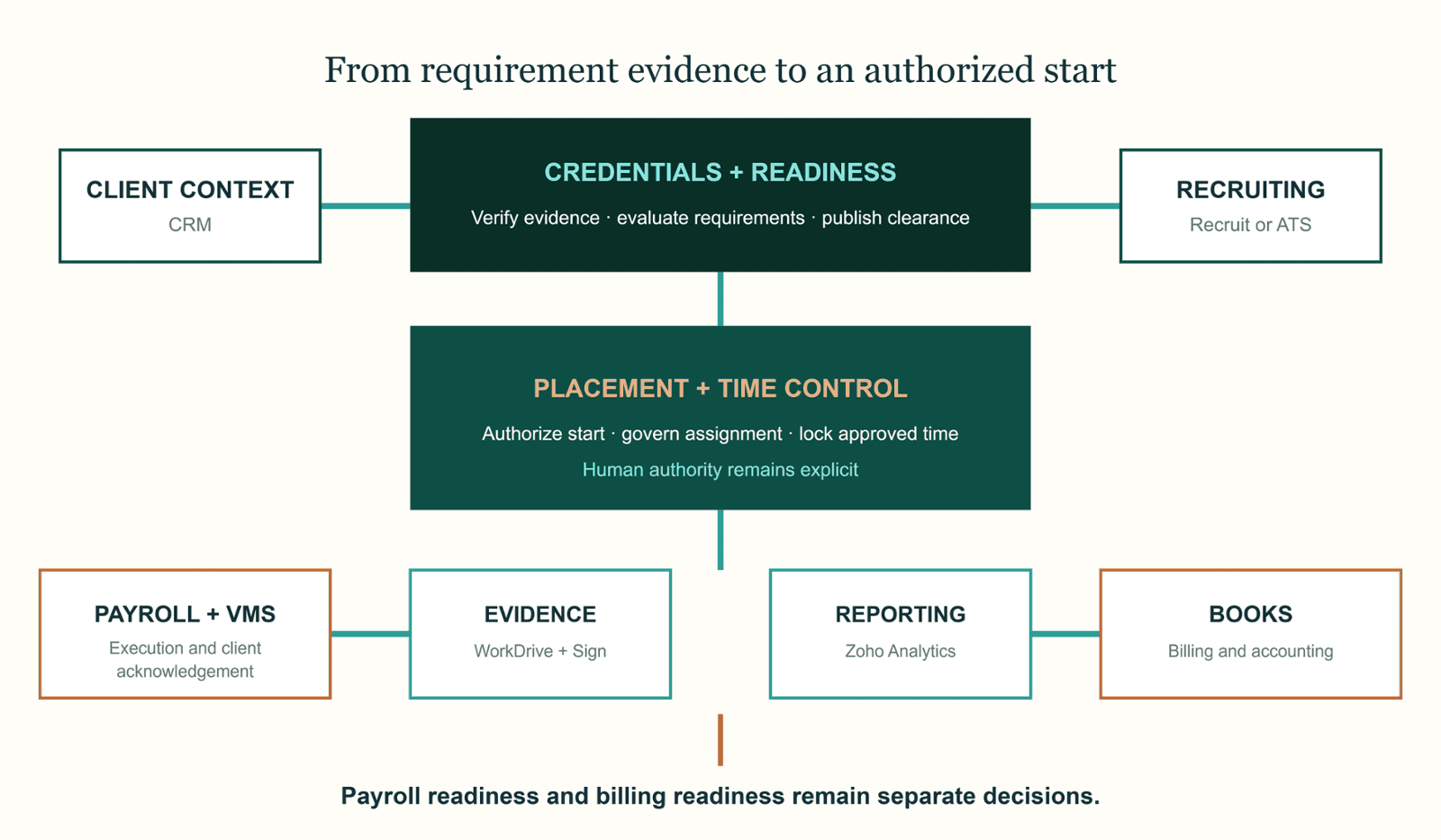
Zoho CRM
Clients, sites, contracts, rates, and commercial context
Zoho Recruit or approved ATS
Candidates, requisitions, and applications
Credentials and Readiness
Verification, requirement evaluation, exceptions, and clearance decisions
Placement and Time Control
Placements, authorized starts, mobilization, operational time, and readiness decisions
WorkDrive and Sign
Controlled evidence and signed artifacts
Payroll and VMS
Payroll execution and client acknowledgements
Books or accounting
Invoices, payments, and balances
Zoho Analytics
Governed reporting, never transaction authority
Control Points
The lifecycle is controlled where operating risk changes.
Each point combines an authoritative record, accountable owner, prerequisites, evidence, decision state, and recovery behavior.
01
Client and requisition readiness
Operational requisitions depend on approved client, site, contract, rate, safety, credential, and VMS context.
02
Worker identity and credentials
Durable identities connect applications while evidence remains subject to accountable verification.
03
Readiness and clearance
Versioned requirement packages produce explainable results for submission, onboarding, start, and continuation.
04
Placement and authorized start
Terms, clearance, payroll enrollment, safety, client confirmation, margin, and human authority are evaluated together.
05
Assignment and time control
Mobilization, holds, approved time, corrections, and evidence remain tied to the authorized placement.
06
Payroll, billing, and reconciliation
Independent readiness decisions govern export and billing while logging and reconciliation preserve recoverability.
Production Reliability
Designed to recover without losing operating truth.
Cross-application work is treated as a sequence of independently committed steps, so partial success remains visible and repairable.
Search before create
Versioned duplicate keys make approved replay repeatable without creating a second worker, placement, authorization, export, or billing event.
Durable identity
Connected records use authoritative and correlation identifiers instead of names, email addresses, or phone numbers alone.
Bounded observability
Automation logs retain outcome and target references without copying sensitive credential or pay information.
Repair forward
Controlled replay and reconciliation identify missing targets, stale syncs, duplicates, and state conflicts.
Verified build evidence
A documented system build, not a performance claim.
The evidence below describes architecture, implementation, testing, and operating documentation. It does not present percentage improvement, savings, or return on investment.
2 Creator control applications
Purpose-built separation between credentials/readiness and placement/time control.
50 governed forms
Operational and reliability records across the two control applications.
18 start checks
Prerequisites are re-evaluated before an authorized start decision.
26 acceptance scenarios
Positive, negative, replay, security, and reconciliation behavior is defined for validation.
Designed to improve
The operating improvements the system targets.
Clearer worker readiness
Teams can distinguish satisfied, pending, missing, expired, rejected, and exception-covered requirements.
Safer start decisions
Operations receives a versioned authorization tied to the evaluated requirement and clearance state.
Visible payroll and billing readiness
Worker-pay obligations remain distinct from client-billing conditions and unresolved evidence.
questions
What buyers usually need to know.
Your next control point
Where does your operating system lose control?
Start with the handoff, decision, evidence, or recovery problem that creates the most friction today.