
6
Service stages
3
Service disciplines
Asset
Continuing service history
Zoho
Connected operating layer
The operating challenge
The service relationship outlasts the appointment.
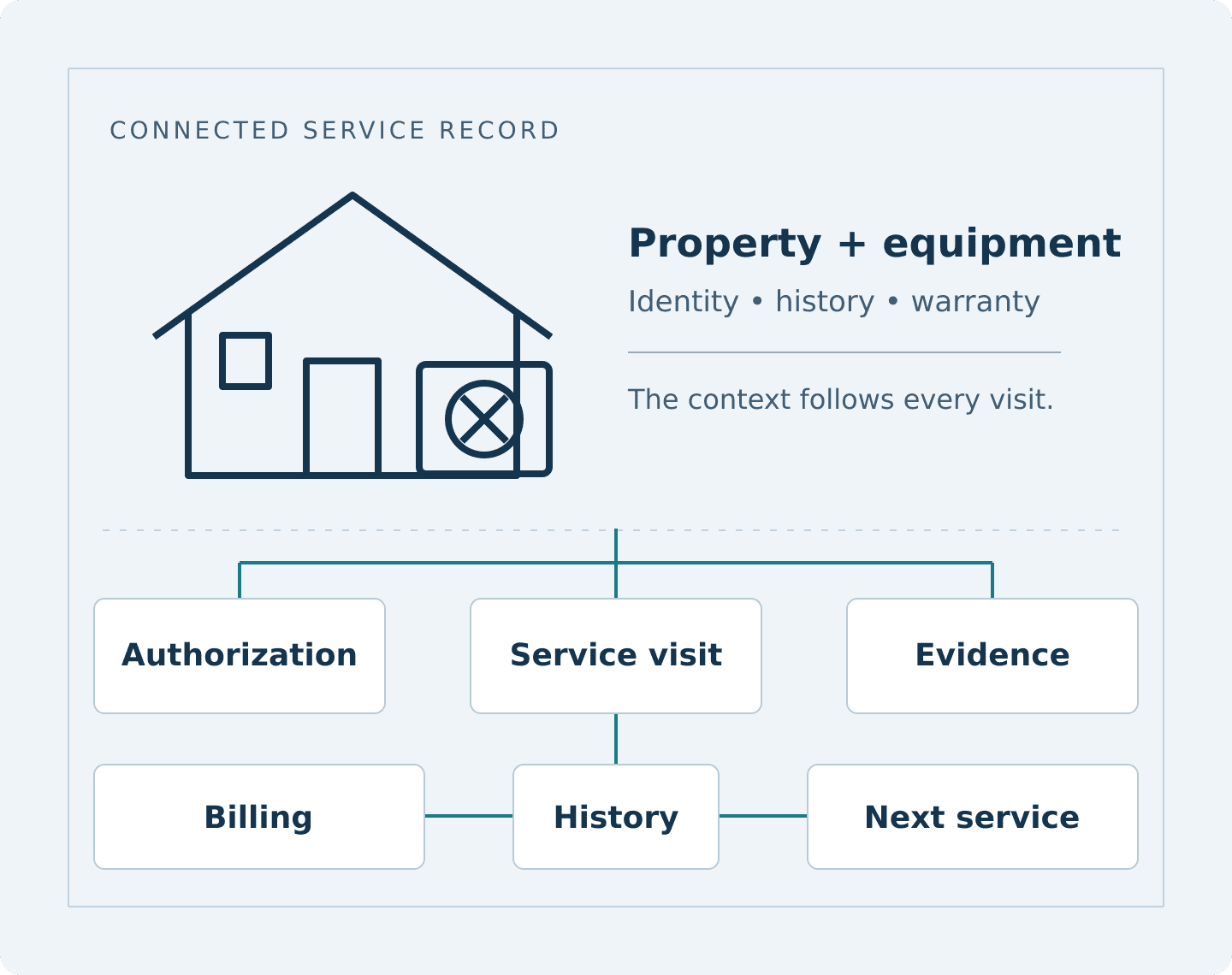
Customers may call about an earlier repair, equipment needs maintenance, and a physically complete installation can still have an open inspection. Finance needs to know which charges are authorized and what supports them. The operating layer preserves this history as work passes between teams.
Distinguish owner, occupant, property manager, authorized contact, and payer.
Keep equipment identity and replacement history across visits.
Separate submitted evidence from reviewed evidence.
Preserve membership benefits and service obligations when appointments move.
Operating-system design
Carry the service context forward without competing transactions.
Customer relationships, compliance records, evidence, exceptions, and reporting connect through Zoho. Mapped identifiers link established dispatch, inventory, membership, and accounting records to the service history; each system retains its defined responsibility.
A scheduling decision remains in the dispatch system.
Financial balances come from the financial system.
A replacement receives a new asset linked to its predecessor.
Approved scope and charge conditions govern billing review.
A rescheduled visit preserves the same membership benefit.
Zoho operating layer
Customer relationships, compliance records, evidence, exceptions, and management reporting.
Existing dispatch system
Existing dispatch system
Existing inventory system
Its defined inventory responsibilities, connected through mapped references.
Existing membership system
Membership agreements, actual benefits, and their assigned source responsibilities.
Existing accounting system
Financial records, invoice balances, and payment status.
Mapped service references
Connect property, equipment, job, and external transaction identifiers across the service history.
Control Points
The lifecycle is controlled where operating risk changes.
Each point combines an authoritative record, accountable owner, prerequisites, evidence, decision state, and recovery behavior.
01
Customer and property context
Link the requester to the correct property, equipment, and authorized contact without conflating owners, occupants, property managers, and payers.
02
Equipment history
Maintain model, serial number, findings, warranty context, and replacement links. New equipment has a new record while its predecessor retains its service history.
03
Work authorization and readiness
Connect diagnostic, repair, installation, and additional-work approvals to their scope. Make prerequisites, technician credentials, and unresolved conditions available to release review.
04
Evidence and compliance review
Organize checklists, readings, photos, permits, and inspections around the job and asset. Submitted and reviewed evidence remain separate, with traceable corrections and follow-up.
05
Billing and collection visibility
Link each charge to its approved basis, payer, evidence, and financial record. Physical completion, billing readiness, invoice status, and payment status remain distinct.
06
Care Club and ongoing service
Connect agreements and actual benefits to service occurrences and fulfillment. Preserve the benefit when a visit moves, and expose due service, missed visits, and renewal exceptions.
illustrative workflow
An HVAC replacement retains its predecessor's history.
An illustration account journey showing how the operating model handles routine fulfilment and an additional relabeling request
01
Request and prepare
Identify the customer, property, existing equipment, and service reason. Link the accepted estimate to the approved work revision, resources, and prerequisites.
02
Perform the replacement
Record the new equipment as its own asset linked to the predecessor, alongside work, parts, findings, and additional authorizations.
03
Review and reconcile
Keep commissioning and applicable inspection evidence attached to the work. Relevant charge conditions govern billing, invoice, and payment reconciliation.
04
Maintain the relationship
Carry warranty and future maintenance to the new unit. A later callback can reference the original job and earlier service history.
Service continuity
Keep the remaining obligation visible after the visit.
Linked history gives the next team the context to review a decision without taking over its authoritative source system.
Asset replacement links
New equipment does not overwrite the predecessor's identity, findings, or repair history.
Reviewable exceptions
Missing evidence, unresolved obligations, and uncertain integration outcomes have explicit review paths.
Separate financial facts
Physical completion does not automatically establish billing readiness, invoice posting, or payment.
Benefit continuity
Membership fulfillment stays linked to the agreement even when an appointment changes.
delivered scope
An implemented customer-to-collection operating layer.
InsightVector's documented role was system architecture and implementation. The portfolio describes connected service records, not quantified performance or regulatory certification.
Connected service lifecycle
Request, preparation, performance, evidence review, financial reconciliation, and ongoing maintenance.
Equipment continuity
Identity, predecessor links, warranty context, inspection evidence, and future obligations.
Retained system authority
Dispatch, inventory, membership, and accounting keep their defined roles through mapped identifiers.
Designed to improve
The operating improvements the system targets.
Clearer handoffs
Teams can see what was approved, what happened, and which action remains open.
Useful asset history
Future decisions can draw on previous findings, repairs, replacements, and warranty context.
Supported billing review
Finance can trace charges to their authorization and service evidence.
Continuity for members
Care Club benefits, fulfillment, missed visits, and renewal exceptions remain connected.
questions
What buyers usually need to know.
Your next control point
Where does your operating system lose control?
Start with the handoff, decision, evidence, or recovery problem that creates the most friction today.