
6
service control areas
4
team perspectives
6
client journey stages
1
warehouse execution authority
THE OPERATING CHALLENGE
Keep the client promise connected to the work.
Warehouse execution is only part of a fulfilment relationship. Client requirements must reach the right team, receiving discrepancies need an owner, special work needs approval, and finance needs a supported record of services performed. When those decisions sit in separate conversations and spreadsheets, teams must reconstruct the account story.
Launch requirements and service commitments need a shared client record.
Receiving discrepancies and additional work need explicit ownership and authorization.
Split shipments, returns, and incomplete source data must remain visible.
Chargeable activity must connect the agreement, rate, approval, and proof.
Operating-system design
A control layer around warehouse execution.
The solution brings commercial context and operational review together in Zoho One. In the ShipHero integration design, ShipHero remains the warehouse execution and stock authority. The surrounding applications manage readiness, client decisions, exceptions, evidence, and financial review.
Keep each client, facility, requirement, owner, and source reference connected.
Apply the agreed service policy, cutoff, working calendar, and completion milestone.
Treat missing source data as unknown, not successful service.
Require current work specifications and approvals when scope changes.
Leave invoice, credit, settlement, and accounting decisions with finance.
ShipHero
Warehouse execution and stock authority; source references for receiving, fulfilment, shipments, inventory observations, and returns.
Zoho CRM
Client relationships, commercial agreements, and onboarding handoff.
Zoho Creator
Readiness, approvals, operational exceptions, service controls, and billing review.
Zoho Desk
Support conversations and response commitments linked to the operational case.
Zoho WorkDrive
Restricted agreements, approvals, and supporting documents.
Zoho Analytics
Reporting with defined measures, source coverage, and refresh context.
Selected accounting system
Draft invoice handoff and financial confirmation. Zoho Books is an option where selected.
Control Points
The lifecycle is controlled where operating risk changes.
Each point combines an authoritative record, accountable owner, prerequisites, evidence, decision state, and recovery behavior.
01
Client onboarding and launch readiness
Connect agreements, operating requirements, system mappings, sample transactions, test results, and launch approval to the client record. Missing prerequisites remain visible before activation, and scope changes require fresh review.
02
Warehouse and fulfilment visibility
Associate receiving, orders, shipment lines, inventory observations, and returns with the correct client and facility. Preserve split-shipment quantities, receiving discrepancies, warehouse references, and source-data age.
03
Service commitments and deadlines
Apply the agreed policy, cutoff, working calendar, and completion milestone to eligible services. Track approaching deadlines, breaches, and completion without treating missing data as a successful outcome.
04
Exceptions and client service
Give receiving, fulfilment, and retailer exceptions a named owner, next action, due time, and resolution record. Link support cases, require closure evidence and review, and preserve history when issues reopen.
05
Returns and additional services
Track return inspection and authorized disposition. Relabelling, kitting, and rework carry a current specification, approval, warehouse reference, measured quantities, and evidence. Changed work receives a new scope review.
06
Billing evidence and finance review
Connect chargeable activity to the agreement, rate, approval, and service proof. Reconcile batches, hold unsupported charges, and check for duplicates before invoice drafts. Finance retains accounting authority.
illustrative workflow
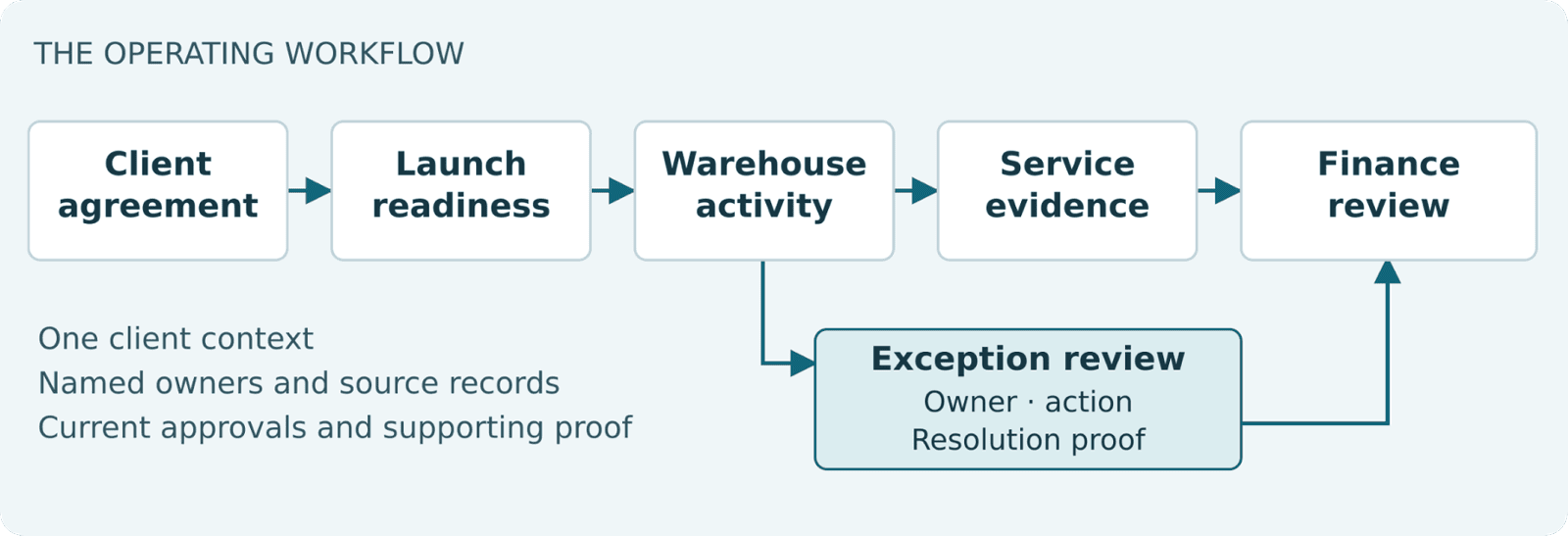
From client agreement to supported charges
An illustration account journey showing how the operating model handles routine fulfilment and an additional relabeling request
01
Agree to the service
Record scope, terms, rates, and approval contracts so the account team and warehouse share the same commercial context
02
Confirm readiness
Review clients and warehouse mappings, documents, and sample transactions. Keep missing prerequisites open until an authorized launch decision is made.
03
Follow warehouse activity
Use confirmed source records to follow receiving, fulfilment, split shipments, discrepancies, and deadlines.
04
Managed changed work
Attach the relabeling specification, approval, completed quantities, and evidence. Unresolved exceptions retain an owner and next action.
05
Review supported charges
Finance reviews service charges. Missing evidence or conflicting rates remain on hold before a draft is created.
06
Review the account
Bring together service performance, open issues, supported unbilled work, and accounting-confirmed invoices and balances.
Operating controls
Keep incomplete work and evidence visible.
The model keeps review decisions close to their source records, so teams can distinguish confirmed activity from unresolved or incomplete information.
Source coverage
Reporting carries source coverage and data-age context instead of implying every warehouse event is current.
Current authorization
Client access is limited to authorized records and actions. Approvals relate to the current work specidfication.
Exception history
An unresolved case retains ownership and next action. Reopening preserves the earlier resolution history.
Financial separation
Evidence reviews and duplicate-charges check preceding drafts; the accounting system confirms invoices and balances.
Verified build evidence
A documented system build, not a performance claim.
The evidence below describes architecture, implementation, testing, and operating documentation. It does not present percentage improvement, savings, or return on investment.
Six control areas
Onborading, warehouse visibility, service commitments, exceptions, returns and additional services, billing evidence.
Four team views
Operations, account management, finance, and leadership each review the records relevant to their decisions.
Define system authority
The ShipHero integration design keeps warehouse execution and stock outside the Zoho control layer
Measurement approach
Positive, negative, replay, security, and reconciliation behavior is defined for validation.
Designed to improve
The operating improvements the system targets.
Operations: actionable exceptions
See approaching deadlines, receiving discrepancies, waiting returns, and the individual responsible for each exception.
Account teams: one client context
Review launch readiness, current commitments, approvals, and decisions needed from client.
Finance: supported billing review
Separate supported billing events from held charges and review reconciliation and draft status.
Leadership: an informed account review
Review service outcomes, recurring issues, and client signals alongside data age and completeness.
questions
What buyers usually need to know.
Your next control point
Where does your operating system lose control?
Start with the handoff, decision, evidence, or recovery problem that creates the most friction today.