
6
Delivery lifecycle areas
4
Team perspectives
Zoho One
Implementation platform
Project
Shared operating record
The operating challenge
Keep cross-team decisions in project context.
An awarded contract must become a project ready to mobilize. Site questions can affect procurement, cost, or schedule, and completed field work needs review and support before it reaches a payment application. iConstruct needed a common structure that follows these handoffs and the evidence behind them.
Carry the approved commercial scope and receiving project manager into delivery.
Keep missing or outdated readiness requirements assigned to an owner.
Trace site records to their document, procurement, schedule, and cost effects.
Distinguish requested, approved, posted, and paid amounts.
Operating-system design
Apply Acnos to the construction delivery lifecycle.
The implementation defines the work, assigns decision ownership, and connects the evidence needed to proceed. Construction records link commercial, project, document, and finance activity, while financial posting and cash balances remain with the designated accounting system.
Give delivery an explicit scope, date, and ownership baseline.
Make mobilization authorization a visible readiness decision.
Preserve current documents and the responses behind coordinated work.
Review owner changes and subcontract changes separately.
Keep physical completion, financial closeout, and warranty obligations individually visible.
Zoho One
Configured platform for the construction operating model and connected workflows.
Commercial records
Pursuits, estimates, bid comparisons, approved scope, owner changes, and contract value.
Construction and project records
Readiness, daily logs, progress, inspections, commitments, procurement, actual costs, and forecasts.
Document and evidence controls
Drawings, RFIs, submittals, review versions, authority, acceptance, and closeout evidence.
Reporting
Project readiness, commercial exposure, billing status, and closeout exceptions with responsible owners.
Designated accounting system
Financial posting and cash balances. Controlled handoffs support operational views without replacing accounting authority.
Control Points
The lifecycle is controlled where operating risk changes.
Each point combines an authoritative record, accountable owner, prerequisites, evidence, decision state, and recovery behavior.
01
Carry approved scope into delivery
Pursuits, estimate versions, and bid comparisons establish the starting point. Award handoff carries scope, exclusions, dates, and the receiving project manager into the project record.
02
Make readiness a visible decision
Review contract authority, budget, leadership, schedule, required permits, vendor readiness, site access, and safety evidence. Missing or outdated information retains an owner and next action before authorized mobilization.
03
Connect site records and decisions
Daily logs, progress, inspections, drawing revisions, RFIs, and submittals remain linked to the project. Teams can trace the current reference, outstanding response, and evidence behind the work.
04
Connect changes to cost and approval
Review scope, price, time, and authority for field changes. Owner and subcontract changes have separate approval records. Commitments, procurement, actual costs, and forecasts show commercial exposure.
05
Bring reviewed work into billing
Owner and subcontract applications connect approved values, verified progress, stored materials, and retainage. Certification, accounting posting, and cash receipts remain separate records.
06
Track the evidence needed to finish
Establish closeout requirements during setup. Punch items, as-built documents, manuals, acceptance records, and warranty cases retain owners and review status through physical and financial closeout.
illustrative workflow
How a field change reaches finance.
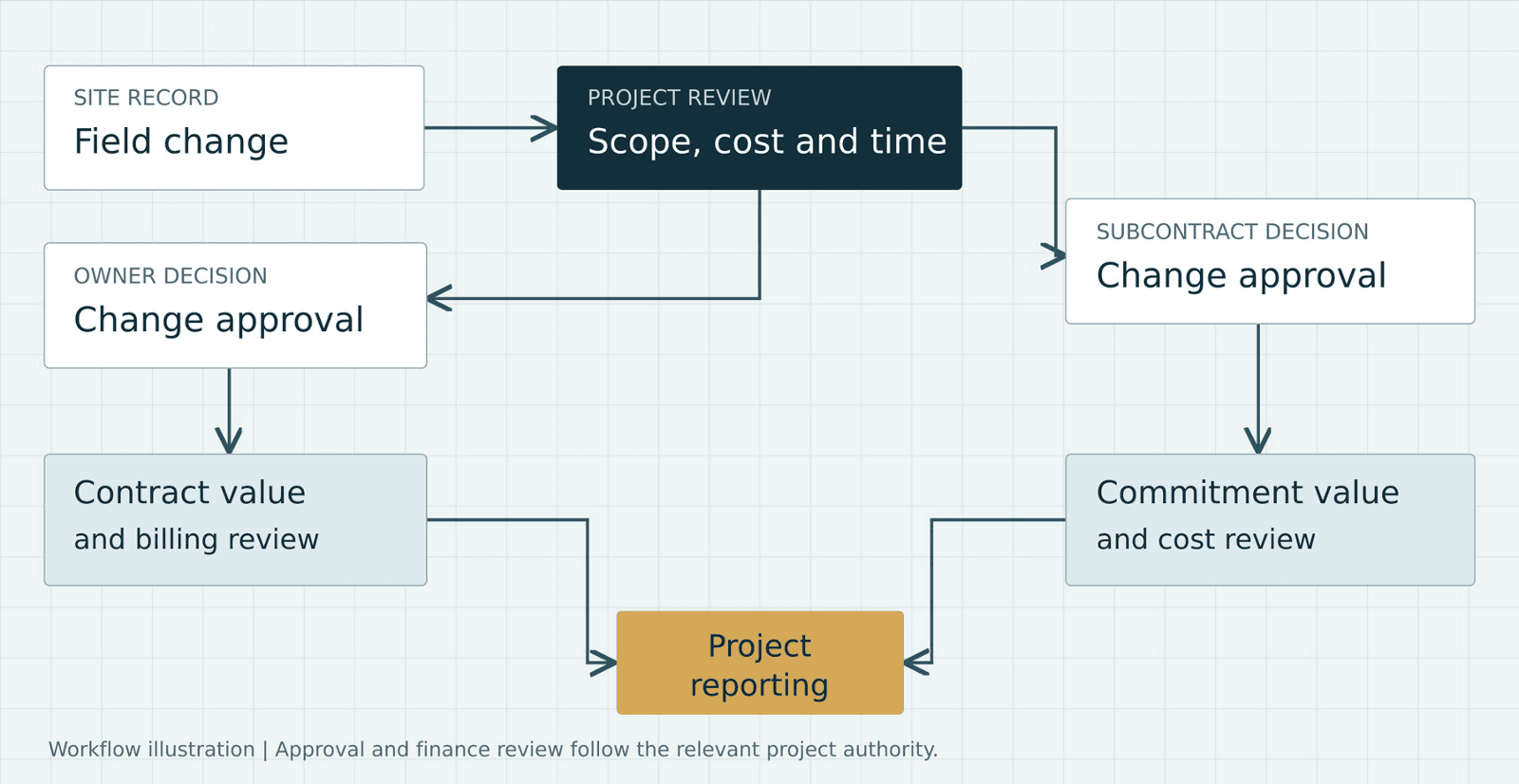
Illustrative workflow: a site condition changes the agreed scope, with separate consequences for owner revenue and subcontract cost.
01
Record the field condition
Link the issue and supporting evidence to the project.
02
Review scope, cost, and time
The project manager reviews scope and schedule effects while the commercial team develops pricing and the approval record.
03
Keep approval paths separate
Owner revenue and subcontract cost receive their respective reviews. Open, disputed, and unapproved changes remain visible.
04
Update authorized values
Approved amounts feed the relevant contract or commitment. Billing follows its own evidence and finance review, with project reporting retaining the connected history.
decision integrity
A received record is not the same as an accepted obligation.
Review steps preserve the version and authority behind a decision, while incomplete handoffs remain visible for reconciliation.
Evidence and verification
The operating model distinguishes a received document from verified evidence and a completed task from an accepted obligation.
Request and approval
Submitted requests retain their own state rather than being treated as authorized changes.
Bounded exceptions
Exceptions retain their scope and expiry, with recorded ownership and supporting context.
Visible handoff recovery
Integration logs and reconciliation queues expose incomplete handoffs for review and resolution.
delivered scope
Workflow design and Zoho One implementation.
InsightVector delivered workflow design, Zoho One configuration, approval and evidence controls, reporting, and implementation documentation. The portfolio describes the implemented operating model, not numerical project outcomes.
Lifecycle implementation
Estimating, mobilization, materials and field delivery, technical coordination, changes and billing, and closeout and service.
Approval and evidence controls
Record structures, lifecycle rules, readiness checks, role responsibilities, evidence requirements, and management views.
Reporting and documentation
Supporting documentation accompanies the change, billing, and operating controls.
Designed to improve
The operating improvements the system targets.
Project managers
Review blockers, unanswered questions, procurement constraints, changes, and forecast movement; assign next actions to named owners.
Field teams
Record progress and inspections, identify current drawings, raise questions or changes, and attach project evidence.
Finance
Review approved applications, reconcile posting and payments, and track retainage separately from cash collected or paid.
Leadership
Review readiness, commercial exposure, billing, and closeout exceptions with their recorded owners and evidence.
questions
What buyers usually need to know.
Your next control point
Where does your operating system lose control?
Start with the handoff, decision, evidence, or recovery problem that creates the most friction today.