
6
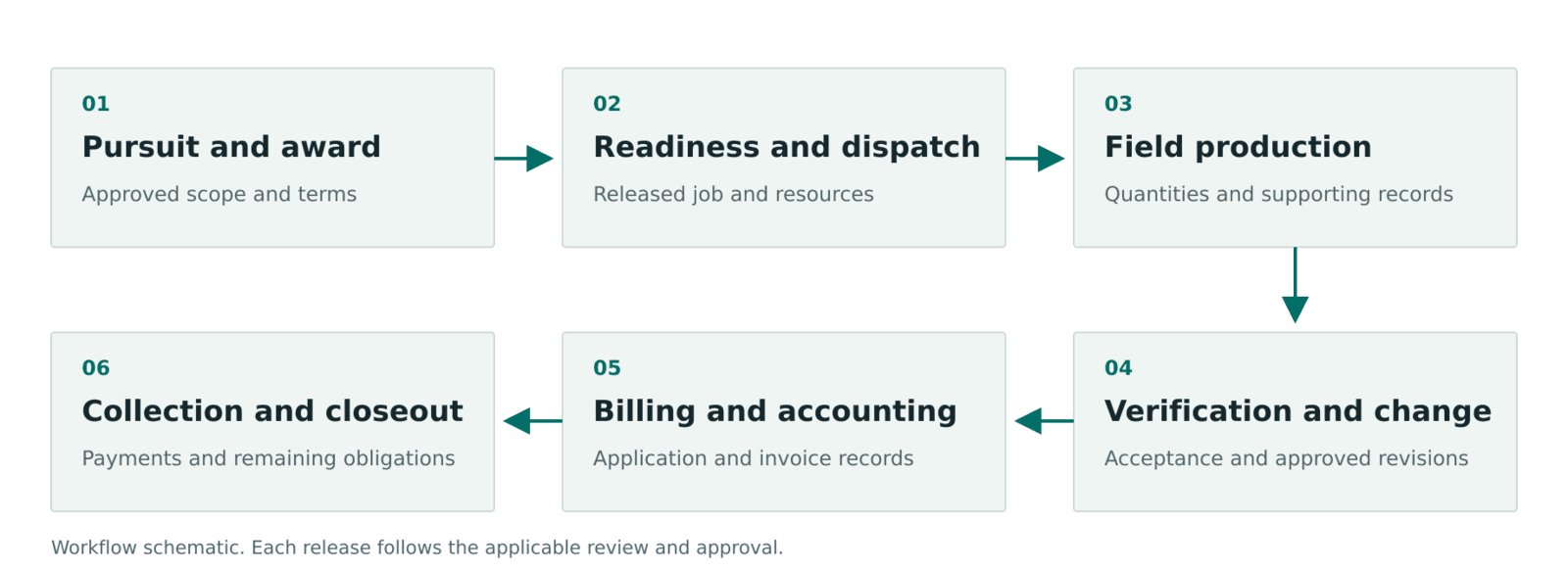
Workflow stages
4
Team perspectives
Civil
Construction context
Job
Shared operating record
The operating challenge
Civil fieldwork crosses several kinds of authority.
Hutchinson's civil sitework, design-build, and program-management environment includes earthwork, utilities, structural work, clearing, and stabilization. An award establishes a commercial commitment, mobilization confirms readiness, verification records what crews performed, and contract acceptance establishes billing eligibility. Each transition needs an owner and supporting evidence.
Carry the approved scope, estimate revision, and contract terms into delivery.
Review crews and equipment against the job, work package, and assignment window.
Preserve quantities, locations, tickets, and acceptance evidence together.
Keep application submission, certification, posting, payment, and retainage release separate.
Operating-system design
Build the operating record around the civil job.
InsightVector connected commercial, resource, field, and financial references through the job. Process design, Zoho configuration, role controls, documentation, and operational handoff establish responsibility without replacing the systems assigned to scheduling, signatures, or accounting.
Verify reported production before it supports downstream decisions.
Match billing evidence and calculations to the contract method.
Distinguish permission to work from price and time approval.
Retain the owner and evidence of blocked handoffs.
Zoho CRM
Commercial context, pursuits, and award handoff.
Zoho Creator
Civil operations, resource assignments, field records, and approvals.
Zoho WorkDrive
Supporting evidence linked to the affected work and decisions.
Zoho Analytics
Management views connecting operational and financial information.
Selected scheduling and signature systems
Their assigned responsibilities remain connected through controlled handoffs.
Designated accounting system
Authoritative posted costs, invoices, credits, receipts, and balances.
Control Points
The lifecycle is controlled where operating risk changes.
Each point combines an authoritative record, accountable owner, prerequisites, evidence, decision state, and recovery behavior.
01
Commercial handoff and mobilization
Carry accepted scope, estimate revisions, contract terms, and owners into delivery. Review authorization to proceed, access, permits, utility coordination, safety preparation, budget, and the resource plan.
02
Crew and equipment coordination
Connect assignments to a job, work package, and time window. Check availability, overlapping assignments, qualifications, inspections, and maintenance holds before dispatch release.
03
Field production with context
Capture quantities, labor, equipment usage, tickets, photos, locations, and drawings. Mobile submissions enter supervisor review and the contract's required acceptance process.
04
Workface changes and verification
An obstruction, instruction, or additional scope becomes a traceable event through notice, assessment, pricing, approval, and incorporation. Work authority stays separate from price and time agreement.
05
Evidence-led billing
Application lines connect production, acceptance, delivery evidence, and approved rates. Consider previously billed quantities and active allocations; apply the appropriate unit-price, lump-sum, time-and-materials, or milestone basis.
06
Collection and closeout
Track punch items, final inspections, turnover documents, and warranty work. Financial closure remains separate so receivables, disputes, and retainage do not disappear when fieldwork finishes.
illustrative workflow
Installed pipe becomes supported billing evidence.
Illustrative utility-work example using the system's review and acceptance model.
01
Record the installation
The crew records installed pipe against the correct segment and contract item.
02
Verify and accept
A supervisor verifies quantities and inspection evidence. The acceptance required by the contract is recorded separately.
03
Allocate eligible work
04
Reconcile finance and changes
Finance reconciles the invoice and payment. An obstruction remains a linked field event with its instruction, work authority, and price approval alongside the original scope.
Operating controls
Keep production, acceptance, and cash distinguishable.
The shared job record connects the evidence behind each decision without treating different approval states as interchangeable.
Resource holds
Overlapping assignments, maintenance holds, and missing readiness requirements stay visible before release.
Contract-specific eligibility
Stored materials, rates, retainage, and supporting records follow the applicable contract rather than one universal billing rule.
Separate financial events
Submission, certification, invoice posting, payment, and retainage release remain individual records.
Owned exceptions
Inspections, deficiencies, delivery records, subcontract progress, and revisions retain their job context for review.
documented build
A connected operating structure for civil delivery.
The portfolio describes the system InsightVector built and its process, configuration, role controls, documentation, and handoff. It does not provide quantified performance results.
Job-centered records
Scope, locations, quantities, resources, contract items, approvals, and payment references.
Production-to-payment controls
A cross-application operating model with explicit system authority.
Operating handoff
Designed to improve
The operating improvements the system targets.
Operations
Project management
Separate verified production from work still awaiting acceptance or change decisions.
Finance
Review billing eligibility, posted invoices, unpaid balances, and retained amounts.
Leadership
Connect delivery progress, commercial exposure, and cash status to a specific decision and owner.
questions
What buyers usually need to know.
Your next control point
Where does your operating system lose control?
Start with the handoff, decision, evidence, or recovery problem that creates the most friction today.