
5
Delivery stages
5
Establish source systems
Zoho One
Control platform
Area
Location-specific readiness
The operating challenge
An awarded project can still contain unready work areas.
FTK's affordable-housing, multifamily-renovation, disaster-services, and roofing work involves properties, buildings, units, phases, and different approval paths. Awarding a contract does not authorize every area to start, and approving a payment package does not mean cash has been received.
Tie readiness to the exact property, building, unit, or phase.
Carry selected bid versions, contract references, scope, and ownership into delivery.
Keep requested changes distinct from approved and implemented changes.
Preserve established construction, scheduling, signature, and accounting processes.
Leadership receives a reconciled story instead of a governed operating view.
Operating-system design
Connect decisions across established systems.
Zoho Creator sits at the center of the control workflow, linking project references to requirements, evidence, decisions, exceptions, and review queues. Controlled imports and named operator handoffs carry source context; Analytics reports across reconciled data and WorkDrive holds governance evidence.
The designated source retains authority for its business records.
Source updates carry a visible freshness status.
Consequential actions retain their source-system receipt.
Material changes can invalidate an earlier readiness result.
Uncertain external outcomes are checked at the source before retrying.
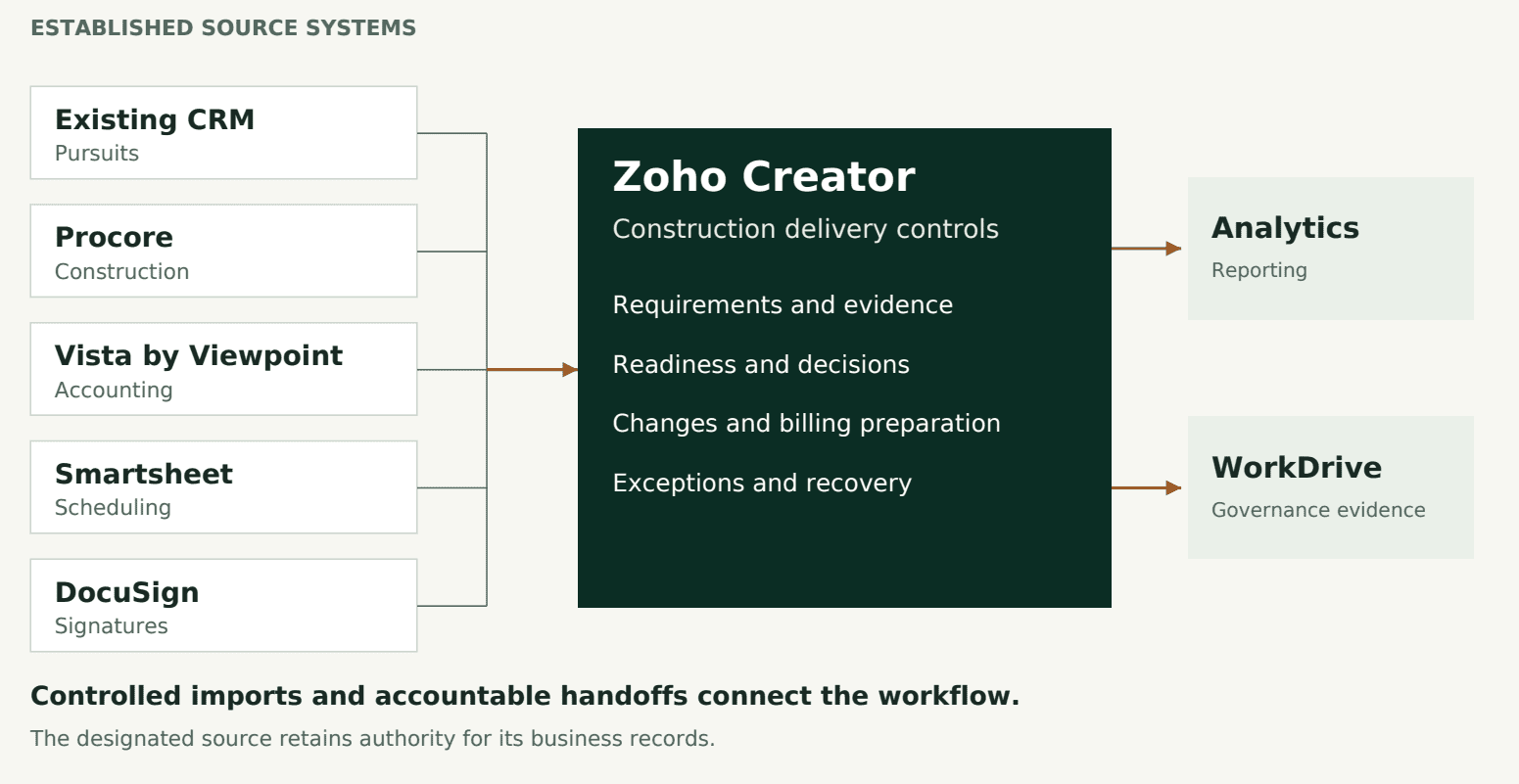
Existing CRM
Pursuits and commercial source context.
Procore
Established construction records and processes.
Vista by Viewpoint
Accounting authority, including financial posting and payment records.
Smartsheet
Established scheduling responsibilities.
DocuSign
Signatures and their source evidence.
Zoho Creator
Requirements, readiness, decisions, changes, billing preparation, exceptions, and recovery.
Zoho Analytics
Reporting across reconciled operational and financial data.
Zoho WorkDrive
Governance documents and controlled evidence references.
Control Points
The lifecycle is controlled where operating risk changes.
Each point combines an authoritative record, accountable owner, prerequisites, evidence, decision state, and recovery behavior.
01
Pursuit and award
02
Mobilization and work release
Review current evidence and missing requirements at property, building, unit, and phase level. Missing or expired prerequisites stay visible until resolved or covered by a permitted documented exception.
03
Delivery and change control
Review constraints, subcontractor readiness, procurement, milestones, and evidence. Disaster-related claim supplements remain separate from the customer's authority to approve work or billing.
04
Billing preparation and collection
Connect the schedule of values, completed work, stored materials, retention, prior certifications, and approvals. Accounting-sourced invoices and payments establish balances independently of billing approval.
05
Closeout and ongoing obligations
Track acceptance, warranties, open obligations, and financial items after fieldwork ends. Physical completion and financial closure remain distinct.
illustrative workflow
Additional renovation work retains its approval trail.
Illustrative workflow using the control model, not a report of a specific FTK project.
01
Identify the work
Link the site issue to the relevant project and location.
02
Price and review
Develop the change and route it to the appropriate decision owner.
03
Approve and implement
Preserve approval and execution evidence. Missing approval leaves the item open rather than making it billable.
04
Reconcile into billing
Review the approved value and supporting evidence against the payment package and authoritative source records.
Accountable handoffs
Recover uncertain actions from their source evidence.
Source freshness, receipts, permissions, and recovery status make the integration model explicit rather than implying uninterrupted automatic synchronization.
Source freshness
Controlled imports expose the age of the source update for the next review.
Contextual approval
Protected records have role permissions, and evidence and approvals are checked in the context of the affected work.
Readiness invalidation
A material change can invalidate a previous readiness result and require a new decision.
Check before retry
When an external action has an uncertain outcome, recovery checks the authoritative source before another attempt.
delivered scope
An implemented workflow around FTK's existing tools.
The portfolio documents the Zoho One implementation and controlled source handoffs. No numerical performance gains or fully automatic integrations are asserted.
Five lifecycle stages
Pursuit, mobilization, delivery and changes, billing and collection, and closeout.
Defined system boundaries
Existing CRM, Procore, Vista, Smartsheet, and DocuSign retain their assigned authority.
Recovery and review
Freshness status, source receipts, contextual approvals, and source-first recovery.
Designed to improve
The operating improvements the system targets.
A clearer next action
Operations can identify the missing input, responsible person, and decision required.
Traceable billing
Finance can follow completed work, approved changes, and evidence into the payment package.
Shared exception context
Leadership can review blockers, changes, holds, and balances with their source context.
Continuity through closeout
Project teams retain evidence and obligations for handover, financial closure, and warranty follow-up.
questions
What buyers usually need to know.
Your next control point
Where does your operating system lose control?
Start with the handoff, decision, evidence, or recovery problem that creates the most friction today.