
36
Creator forms specified
573
Field definitions
60
Document rules
72
Acceptance tests defined
The operating challenge
Preserve the connection between scope, assets, and evidence.
Caruth's fire-protection and life-safety service context spans alarms, sprinkles, inspections, and special hazards. The operating challenge is to know what is due at each site, who is qualified for the exact work, what was actually inspected, what remains open, and evidence supports a report or invoice.
Recurring service obligations must stay connected to sites and real assets.
Technical eligibility must cover the specific scope and full planned work interval
An inaccessible or untested asset cannot silently become completed scope.
A paid invoice or declined repair does not resolve a technical deficiency.
Operating-system design
One operating model. Distinct Decision rights.
InsightVector developed the operating model and implementation package to preserve relationships between agreed scopes, authorized work, asset observations, evidence, and review decisions. Native Zoho records remain authoritative for the work they own, with explicit responsibilities for existing HR, payroll, and specicialist inspection systems.
Reconcile expected recurring visits with scheduled work through an independent due date register.
Recheck job-specific eligibility before appointment release.
Record inspection evidence at asset level against the approved checklist version.
Keep technical acceptance separate from contractual billing readiness.
Make access, versions, decisions, and unsuccessful handoffs traceable.
Zoho CRM
Customers, commercial commitments, and agreed service scope
Zoho FSM
Work orders, appointments, resources, native asset identity, and actual field time.
Zoho Creator
Service obligations, qualifications, inspections, deficiencies, and release controls.
Zoho Workdrive
Private evidence associated with the relevant operational records.
Zoho Books
Native invoices, tax, payments, and receivables.
Zoho Analytics
Operational reporting across service coverage, review progress, and commercial follow-through.
Zoho Desk and Flow
Supporting intake and integration, where appropriate, to the implementation.
Existing specialist systems
HR, payroll, and specialist inspection responsibilities remain explicit rather than being silently replaced.
Control Points
The lifecycle is controlled where operating risk changes.
Each point combines an authoritative record, accountable owner, prerequisites, evidence, decision state, and recovery behavior.
01
Service obligations tied to real assets
Link contracts, sites, installed systems, assets, and recurring obligations. Reconcile expected visits against scheduled appointments so missed occurrences remain visible. Preserve asset identity and replacement history.
02
Qualifications for the actual job
Check employment status, verified credentials, authorized scope, availability, and equipment across the planned work interval. Require a fresh eligibility check and confirmation of the resulting appointment before release.
03
Inspection evidence against scope
Use the expected asset list and current approved checklist version. Record asset-level observations and evidence. Missing, inaccessible, and untested items remain incomplete even when useful work was completed during the visit.
04
Deficiencies through verified retest
Track findings through review, quotation, repair, and verified retest. Customer decline and invoice payment do not close a defect. Impairment response and notices remain independent of billing.
05
Separate report and billing review
Technical review determines report release. Finance evaluates the contractual billing basis, scope, and evidence before native invoicing. Field completion, technical acceptance, and billing readiness are not interchangeable.
06
Traceable decisions and recoverable handoffs
Specify role-based access, private evidence, version history, and decision logs. Account for duplicate requests, interrupted transactions, and reconciliation so failed cross-application handoffs remain visible.
illustrative workflow
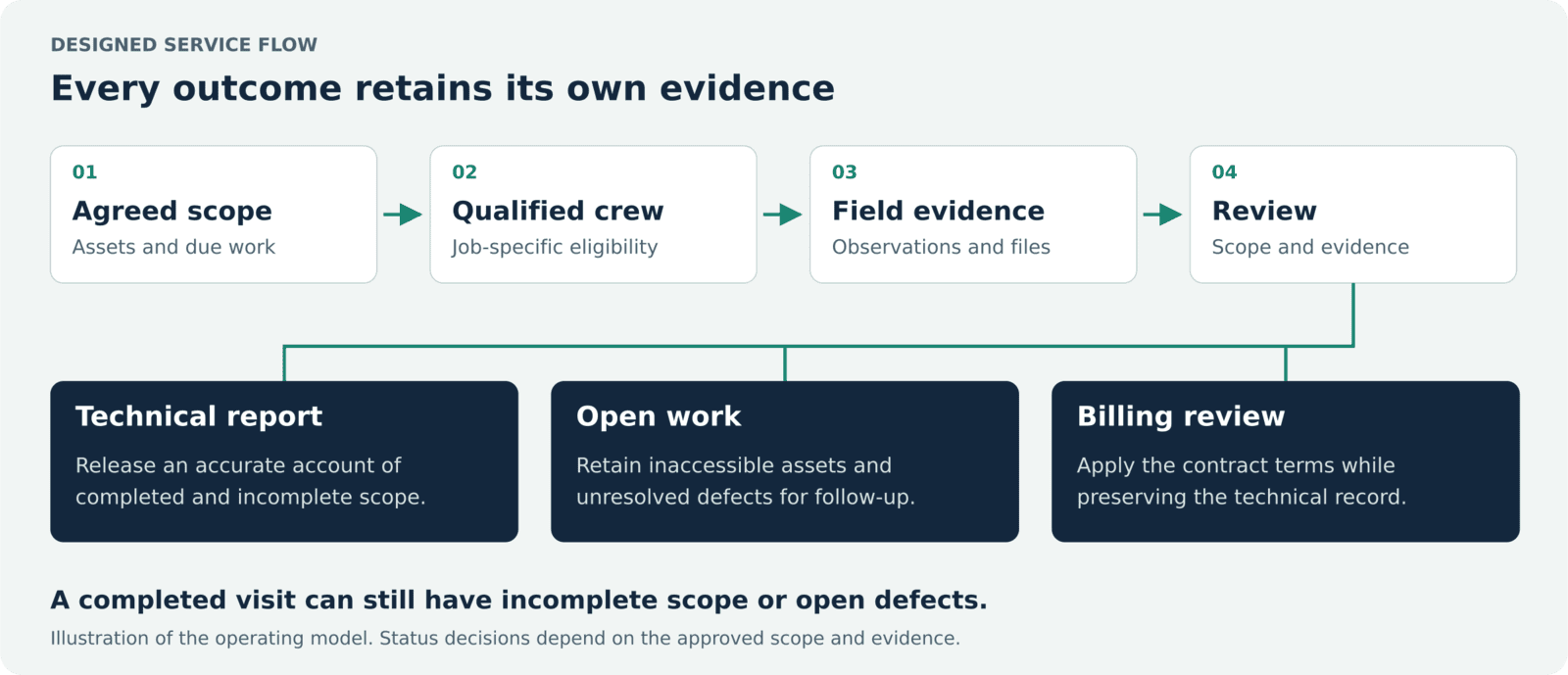
One inaccessible asset. Three distinct review outcomes.
An illustration account journey showing how the operating model handles routinAn illustrative recurring inspection shows why a completed service visit does not automatically satisfy every obligation or resolve every defect.e fulfilment and an additional relabeling request
01
Plan and qualify
Connect the due obligation to the service scope and crew requirements. Confirm job-specific eligibility before releasing the appointment.
02
Record the work
Capture completed checkpoints and explicitly record the inaccessible asset. Attach observations and evidence to the asset and visit.
03
Review the outcome accurately
Release an appropriately qualified technical report while keeping the unfilled scope and any unresolved findings open for follow-up.
04
Evaluate the billing basis
Apply the contract terms and supporting evidence. A billing decision does not erase incomplete scope or a technical defect.
reliability design
Make interrupted work recoverable and reviewable.
The implementation package specifies decision records, integration contracts, migration checks, and operational ownership for normal work and unsuccessful handoffs.
Decision traceability
Role permissions, private evidence, versioned records, and decision logs define who may act and what supports the action
Duplicate handling
Integration specifications account for repeated requests so duplicate delivery does not silently create duplicate business work.
Reconciliation and recovery
Interrupted transactions and failed handoffs remain visible for review, recovery, and reconciliation across applications.
Operating ownership
Migration checks, recovery procedures, and daily ownership accompany the technical configuration rather than ending at application setup.
Verified build evidence
A documented system build, not a performance claim.
The evidence displayed describes architecture, implementation, testing, and operating documentation. It does not present percentage improvement, savings, or return on investment.
36 Creator forms/573 fileds
Specified data structures and field definitions for the operating model.
60 rules/9 blueprints
Documented workflow rules and lifecycle blueprints connecting prerequisites, actions, and decisions states.
16 integration specifications
Cross-application contracts describing system responsibilities and handoff behavior.
72 acceptance tests defined
Acceptance scenarios for implementation validation; execution and pass results are not asserted by this portfolio.
Designed to improve
The operating improvements the system targets.
Operations: clear work coverage
Identify uncovered work, scheduling requirements, and job-specific qualification blockers.
Service review: visible incomplete scope
Distinguish due obligations, incomplete inspections, unresolved findings, and technical reporting status.
Finance: evidence-led readiness
Separate work waiting for evidence from work ready for contractual billing review.
Leadership: connected operating visibility
Review service coverage, report turnaround, billing delays, receivables, and renewal context without collapsing different decision states
questions
What buyers usually need to know.
Your next control point
Where does your operating system lose control?
Start with the handoff, decision, evidence, or recovery problem that creates the most friction today.