
6
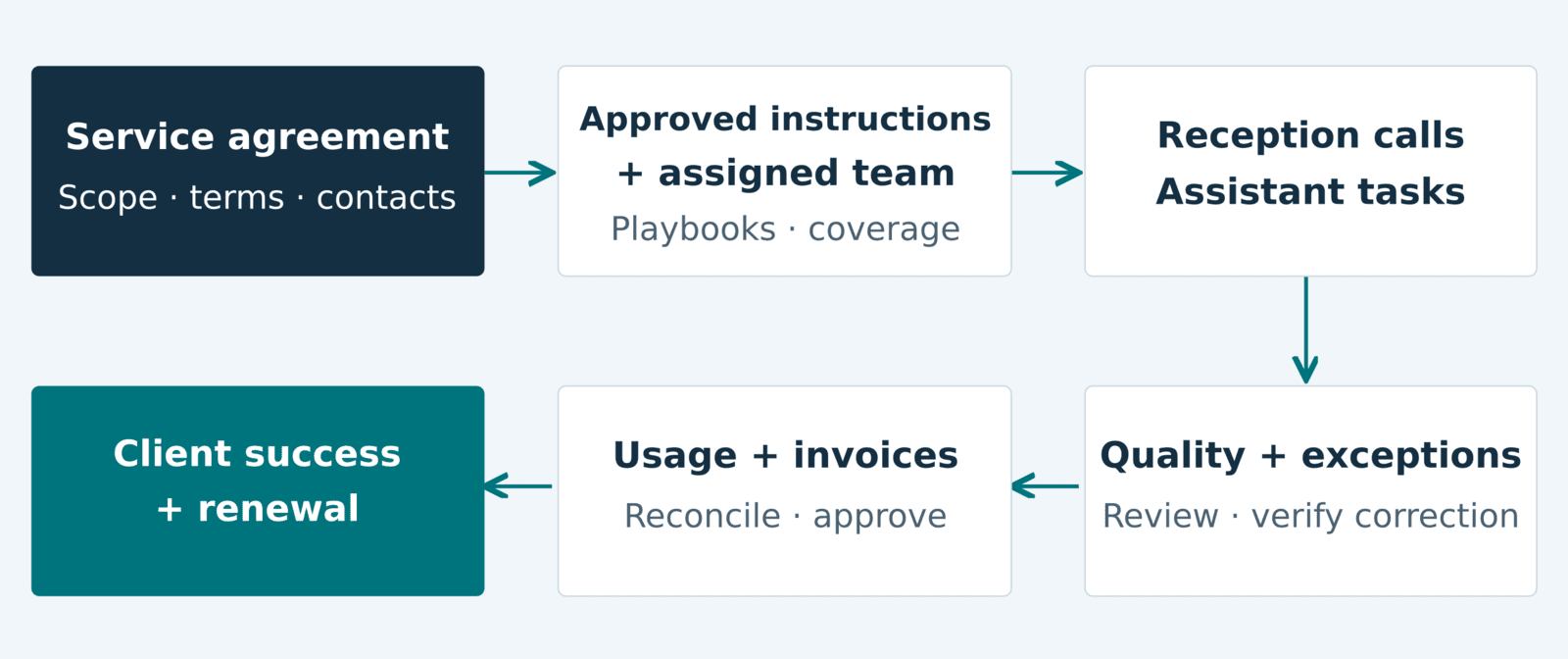
Service stages
2
Distinct service models
4
Team perspectives
Zoho One
Implementation platform
The operating challenge
Client-specific service needs client-specific controls.
Back Office Betties provides legal reception and virtual assistant services for law firms. Each firm brings intake questions, routing preferences, escalation contacts, working arrangements, and commitments. The implementation keeps agreements, instructions, staffing, activity, quality findings, and financial evidence connected as work changes hands.
Link approved instructions to the people assigned to use them.
Distinguish an assistant's acknowledgment from accepted completion.
Keep critical quality findings visible even when the overall score is strong.
Apply reception minutes and assistant hours to their respective billing rules.
Operating-system design
Two delivery models within one firm relationship.
Reception services connect call-handling, intake, routing, backup coverage, metadata, and quality review. Assistant services connect authorized requests, assignment, acknowledgment and completion deadlines, acceptance evidence, and independently approved time. Each model retains its own commercial terms.
Current playbooks, training acknowledgment, coverage, access, and evidence inform activation.
Quality findings refer to the instructions that applied to the work.
Source activity is reconciled into a reviewed billing period.
Client success retains service history, financial context, and renewal obligations.
Client matter information stays in its authorized source systems.
Zoho One commercial records
Firm relationships, authorized contacts, agreements, service profiles, and commercial terms.
Operational delivery and onboarding
Approved playbooks, assigned coverage, requests, readiness, and activity references.
Quality, support, and evidence
Findings, corrective actions, verification, support references, and controlled documents.
Management reporting
Service views and reporting definitions for operations, finance, and client success.
Telephone and client legal systems
Retain their operating roles. Selected metadata connects service, while client matter information stays in authorized legal systems.
Chosen finance system
Owns financial records, with invoice references and status available to service teams.
Control Points
The lifecycle is controlled where operating risk changes.
Each point combines an authoritative record, accountable owner, prerequisites, evidence, decision state, and recovery behavior.
01
Establish the service commitment
Firm records, authorized contacts, signed agreements, scope, and terms establish the commitment. Reception and assistant profiles share the relationship but retain their own billing rules.
02
Prepare instructions and coverage
Connect approved playbooks to assigned staff. Review primary and backup coverage, training acknowledgments, access checks, and readiness evidence before activation.
03
Track calls and assistant work
Link call and intake metadata to the service profile. Assistant requests move through assignment, acknowledgment, work, review, and acceptance, with response and delivery recorded separately.
04
Review quality and resolve exceptions
Link findings to activity and applicable instructions. Exceptions retain owners, corrective actions, and verification evidence. A strong aggregate score does not hide a critical issue.
05
Connect usage to reviewed billing
Eligible calls and approved assistant time follow distinct units, allowances, and rates. Reconcile source activity to the billing period and connect approved charges to invoice references.
06
Bring history into renewal
Combine quality, unresolved issues, usage, financial status, and next actions in client reviews. Contract dates and notice requirements guide renewal; changes and offboarding preserve history.
illustrative workflow
A changed intake instruction reaches verified delivery.
Illustrative workflow: a law firm requests a change to how a particular inquiry is handled.
01
Link and assess the request
Connect the change to the agreement and service profile. Review its impact on instructions, staffing, and billing.
02
Approve the replacement playbook
Approve the new version and record the assigned team's acknowledgment.
03
Update and verify delivery
Update the operating configuration and verify the release rather than assuming approval alone changed service.
04
Retain the applicable version
Later quality reviews reference the version used for the work. Client success sees both the request and evidence that it reached delivery.
Service controls
Preserve the agreement, instruction version, and evidence.
Role-based workflows, approval controls, service views, recovery procedures, and operating routines support changing client requirements.
Version-aware quality
Findings connect to the instruction version that applied at the time of service.
Critical issues stay visible
A critical quality issue remains open to review even if the overall score is strong.
Independent service units
Reception minutes and assistant hours follow their respective allowances, rates, and approval requirements.
Authorized information boundaries
Selected service metadata connects workflows without moving client matter information out of authorized legal systems.
delivered scope
An implemented contract-to-renewal operating model.
InsightVector translated the service journey into connected records, workflows, approvals, views, and reporting definitions, supported by guidance, testing scenarios, recovery procedures, and operating routines. No numerical service results or passed-test counts are asserted.
Two service models
Reception delivery and assistant work retain their separate profiles, deadlines, units, approvals, and rates.
Operating implementation
Connected records, role-based workflows, approval controls, service views, and reporting definitions.
Implementation support
Guidance, testing scenarios, recovery procedures, and maintainable operating routines.
Designed to improve
The operating improvements the system targets.
Operations
Review current instructions, qualified coverage, access, readiness, and service exceptions together.
Quality and support
Trace an event or task to its review, corrective action, support reference, and verification.
Finance
Follow eligible usage and approved time through terms, reconciliation, billing approval, and invoice references.
Client success
Bring service history, open issues, usage, financial context, and next actions into client reviews and renewal.
questions
What buyers usually need to know.
Your next control point
Where does your operating system lose control?
Start with the handoff, decision, evidence, or recovery problem that creates the most friction today.