
6
Connected delivery areas
5
Team perspectives
Zoho One
Implementation platform
Job
Shared operating record
The operating challenge
Keep the sold scope connected to delivery and service.
Electrical projects cross estimating, project management, field crews, inspectors, customer representatives, and finance. All Tech Electric's industrial, commercial, and specialty work spans construction, installation, maintenance, and repair. The implementation preserves the relationship between what was sold, what was performed, what was accepted, and what can enter billing review.
Carry the bid revision and exclusions into the awarded job.
Give crews current information, material commitments, and clear work packages.
Preserve inspection, correction, and reinspection history.
Carry asset and warranty context into authorized follow-up service.
Operating-system design
One job record connects the teams that move work forward.
InsightVector brought together the record structure, lifecycle rules, readiness checks, role responsibilities, evidence requirements, change and billing controls, management views, and implementation documentation. Connected applications retain clear responsibilities for the information they maintain.
Retain the accepted commercial baseline and its receiving owners.
Make missing mobilization prerequisites and active holds visible.
Connect procurement promises and receipts to work-package needs.
Record work authorization and price agreement separately.
Keep operational completion, financial closure, and ongoing service distinct.
Zoho One
Platform supporting the connected electrical-delivery operating process.
CRM and job-control records
Commercial context, accepted scope, ownership, and electrical-delivery workflows.
Document references
Current drawings, RFIs, submittals, inspections, and evidence kept in job context.
Management reporting
Readiness blockers, field activity, materials, commercial decisions, and service continuity.
Selected accounting system
Authoritative posted invoices, credits, and payments, connected through defined handoffs.
Asset and service records
Customer, site, original-job, warranty, and authorized follow-up work context.
Control Points
The lifecycle is controlled where operating risk changes.
Each point combines an authoritative record, accountable owner, prerequisites, evidence, decision state, and recovery behavior.
01
Estimating and award handoff
Carry the customer, site, bid revision, scope, exclusions, and approvals into the awarded job. Delivery and finance receive a defined baseline with contract and estimate references.
02
Mobilization and crew readiness
Review the job plan, owners, crew eligibility, site access, required documents, and holds. Work packages connect scheduled activity to the people, quantities, and evidence needed to deliver it.
03
Materials and field delivery
Connect material requests, specifications, promised deliveries, and receipts to work-package needs. Daily reports, time, and installed quantities support review of progress, shortages, and field issues.
04
Technical coordination and inspection
Keep RFIs, submittals, drawing revisions, inspections, and defects linked to the job. Correction and reinspection records show what was found, what changed, and how acceptance was established.
05
Change control and billing readiness
Separate work and price authorizations. Prepare billing from the agreed value breakdown, supported progress, eligible stored materials, retainage, and prior certified amounts before finance reviews the handoff.
06
Closeout and continuing service
Gather acceptance records, as-built information, manuals, and warranty documents. Asset and service records preserve customer, site, and original-job references for warranty decisions, authorized service, and recurring maintenance.
illustrative workflow
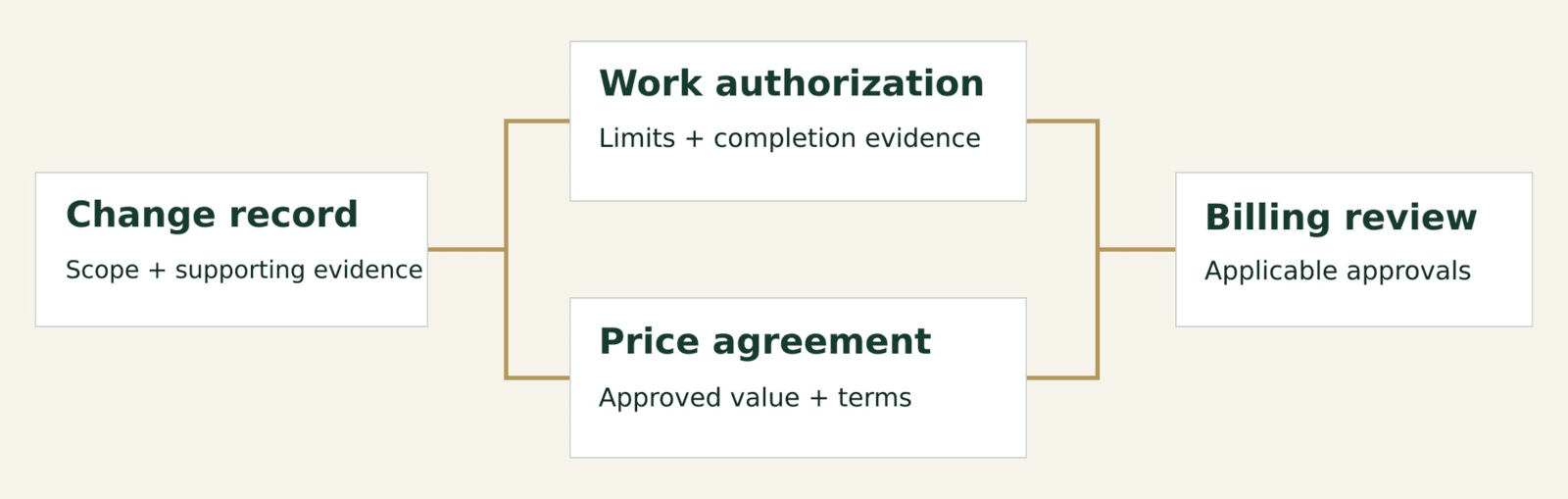
A drawing revision becomes a controlled change.
Illustrative workflow: a revised drawing changes an electrical installation and needs both delivery and commercial review.
01
Record the revision
The field team raises the issue and links the revised document to the job.
02
Review scope and schedule
The project manager reviews the effect on the work and obtains the applicable work authorization.
03
Record the price decision
Price approval follows its own review, preserving limits, terms, and unresolved exposure.
04
Complete and support billing
Execution evidence supports completion. The agreed change enters billing review, and the decision history remains available through closeout and service.
continuity and control
Different decisions retain a connected record.
The system keeps production, acceptance, commercial agreement, accounting, and service history distinct while linking each to the same job.
Separate authorizations
An extra-work instruction does not imply price agreement. Approved limits and unresolved exposure remain visible.
Cumulative progress
Installed work and current stored materials are tracked separately. Installed materials leave the stored balance before application calculations.
Contractual billing context
Retention and prior certified amounts inform the application; payments remain accounting records.
Service after construction
Operational acceptance can coexist with open financial actions. Service teams retain asset and warranty history.
delivered scope
An implemented structure from commitment to customer service.
The implementation connects commercial, field, technical, and finance handoffs. The portfolio describes the delivered operating structure without asserting numerical performance improvements.
Six implementation areas
Estimating, mobilization, materials and field delivery, technical coordination, changes and billing, and closeout and service.
Operating configuration
Record structures, lifecycle rules, readiness checks, role responsibilities, evidence requirements, and management views.
Implementation documentation
Supporting documentation accompanies the change, billing, and operating controls.
Designed to improve
The operating improvements the system targets.
Estimating
Retain the bid revision, exclusions, and accepted baseline.
Project management
Review readiness blockers, field progress, material risks, and unresolved changes.
Field teams
Follow assigned work, current references, daily reporting, and issue capture.
Finance
Review supported application amounts, approval evidence, and accounting status.
Service
Use site and asset history, warranty decisions, and authorized follow-up context.
questions
What buyers usually need to know.
Your next control point
Where does your operating system lose control?
Start with the handoff, decision, evidence, or recovery problem that creates the most friction today.