
24
controlled implementation stages
8
connected Zoho applications
13
build - authority volumes
40
role - based operating procedures
The operating challenge
The problem was never another missing app. It was the handoff.
Professional-services organizations can have capable applications and committed teams yet still lose operating truth when responsibility moves between sales, delivery, finance, and leadership.
Sold work reaches delivery without structured scope, assumptions, dependencies, or ownership.
Projects begin before access, data, approvals, or client responsibilities are ready.
Change moves ahead of an authorized commercial and delivery decision
Finance reconstructs billability from disconnected evidence and acceptance records.
Leadership receives a reconciled story instead of a governed operating view.
Operating-system design
One operating model for the decisions between applications.
InsightVector designed Acnos so each Zoho application keeps a clear purpose while a controlled record graph carries identity, state, evidence, authority, and recovery across the delivery lifecycle.
One authority for each material data element.
One canonical identifier carried across connected records
Evidence before consequential progression.
Search before create for duplicate-sensitive actions.
Target identifiers written back to the source record.
Partial success recorded and reconciled instead of hidden.
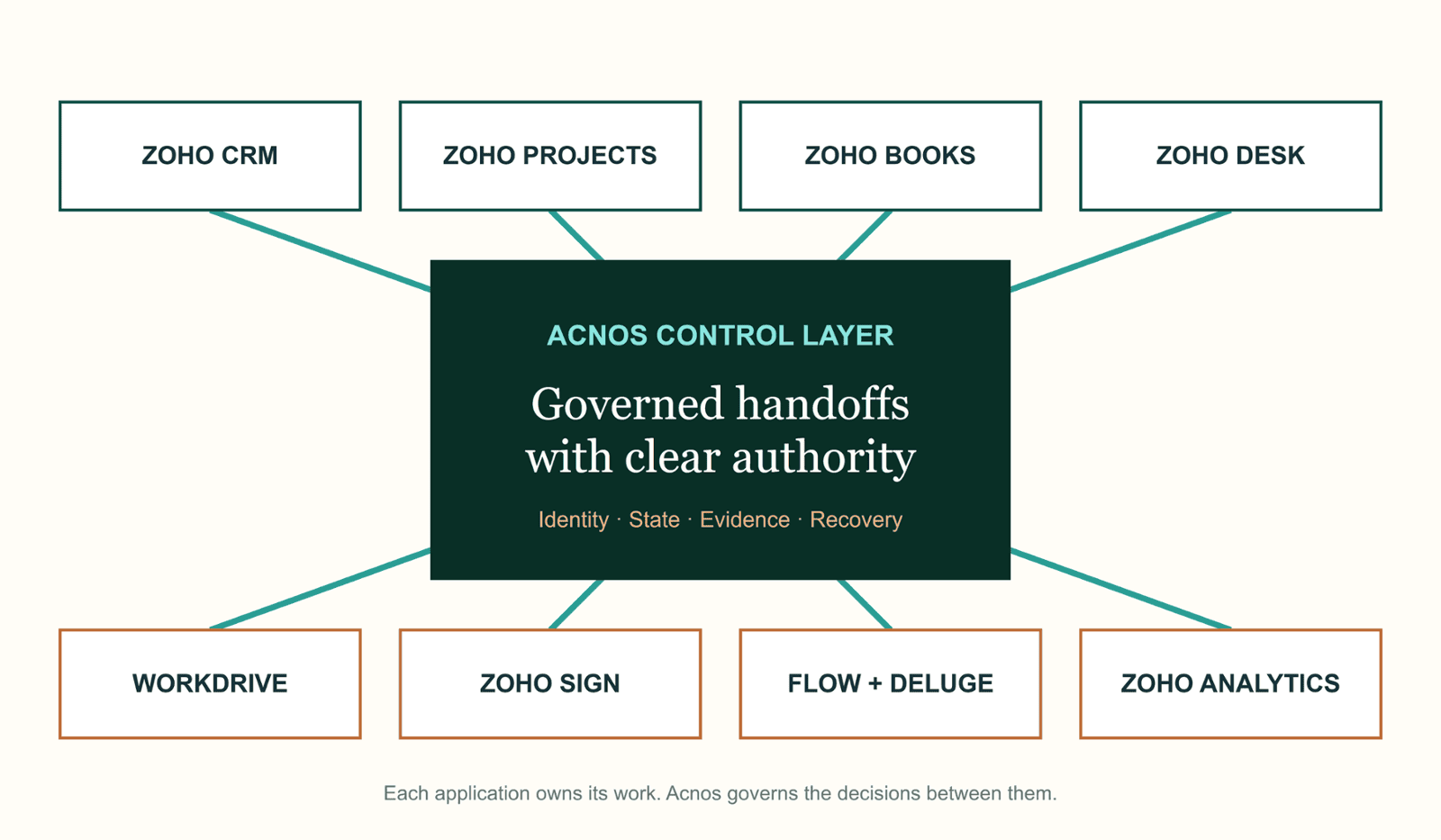
Zoho CRM
Commercial context, delivery readiness, change authority, and lifecycle control
Zoho Projects
Project execution, milestones, work, time, and delivery activity
Zoho Books
Customer finance, invoices, payments, and accounting state
Zoho Desk
Post-delivery stabilization and service operations
Zoho WorkDrive
Controlled evidence and governed delivery artifacts
Zoho Sign
Signature execution and signed-document evidence
Zoho Flow and Deluge
Orchestration, procedural logic, writeback, and logging
Zoho Analytics
Governed reporting and management insight, never transactional authority
Control Points
The lifecycle is controlled where operating risk changes.
Each point combines an authoritative record, accountable owner, prerequisites, evidence, decision state, and recovery behavior.
01
Sales to delivery
Commercial context becomes delivery-ready work only after scope, ownership, dependencies, risks, and prerequisites are understood.
02
Project to cash
Delivery progress and acceptance evidence support billing review without allowing automation to invent financial authority.
03
Change and acceptance
Requests move through impact assessment, authorization, delivery, evidence, and acceptance as one traceable path.
04
Support stabilization
Closeout and post-launch service remain distinct while sharing project, issue, owner, and resolution lineage.
05
Proof and renewal
Production Reliability
Designed to recover without losing operating truth.
Cross-application work is treated as a sequence of independently committed steps, so partial success remains visible and repairable.
Search before create
Duplicate-sensitive actions locate a valid target before creating another record.
Trace one transaction
A correlation identifier follows source, target, writeback, and logging across the handoff.
Preserve completed work
Successful target identifiers remain visible when a later step fails.
Control consequential replay
Project creation, invoices, signatures, and client communication require an approved recovery path.
Verified build evidence
A documented system build, not a performance claim.
The evidence below describes architecture, implementation, testing, and operating documentation. It does not present percentage improvement, savings, or return on investment.
24 controlled stages
A documented implementation lineage from foundation through proof and reliability controls.
8 connected applications
A cross-application operating model with explicit system authority.
13 authority volumes
Product definition spanning governance, architecture, data, automation, security, QA, operations, analytics, and evidence.
40 operating procedures
A practical delivery playbook from qualification and design through support and improvement.
Designed to improve
The operating improvements the system targets.
Visible readiness
Teams can see which prerequisites hold work and who owns the next decision.
Traceable delivery evidence
Acceptance, change, and billing review remain connected to their supporting records.
Recoverable automation
Partial success, identifiers, retry authority, and reconciliation stay understandable.
questions
What buyers usually need to know.
Your next control point
Where does your operating system lose control?
Start with the handoff, decision, evidence, or recovery problem that creates the most friction today.